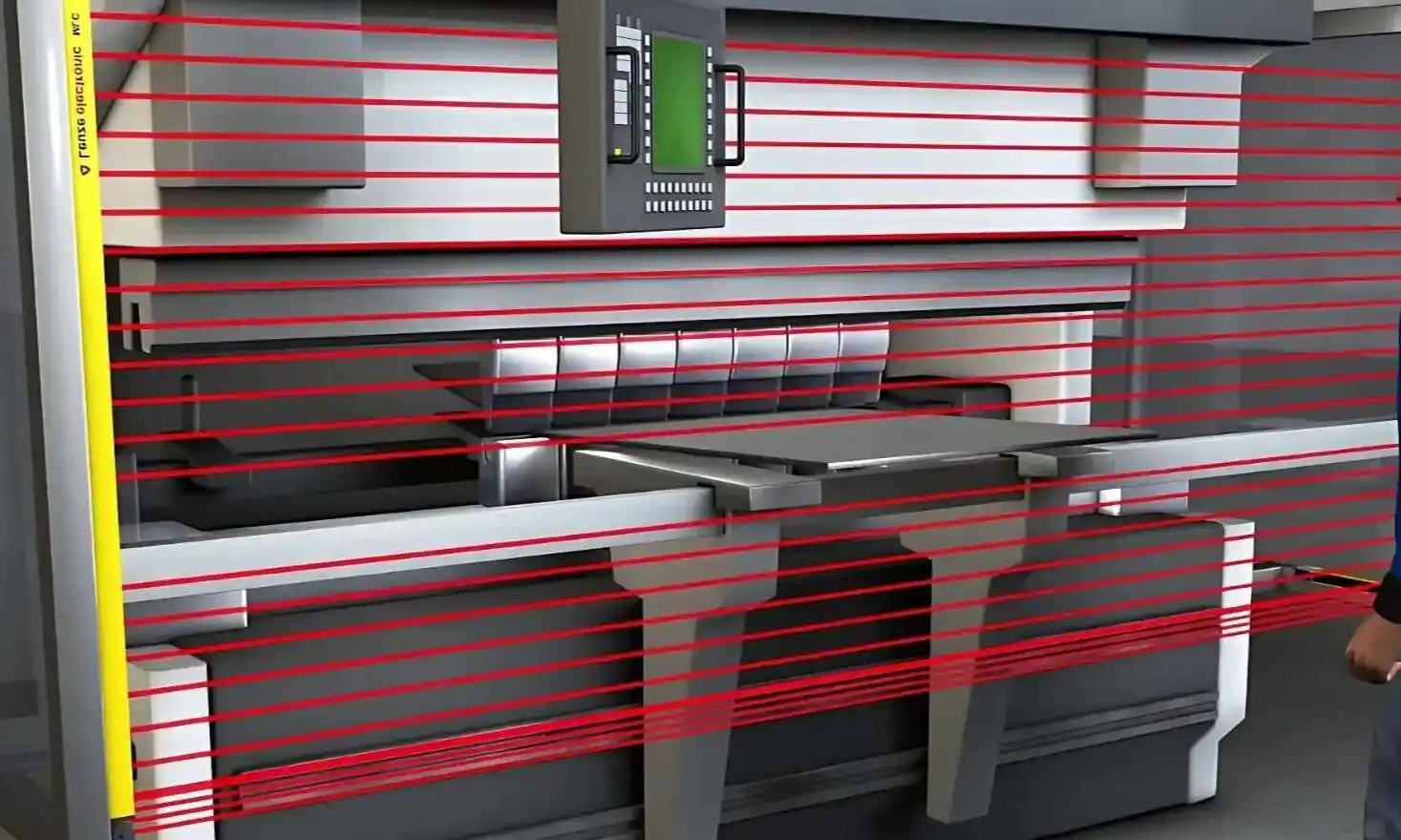
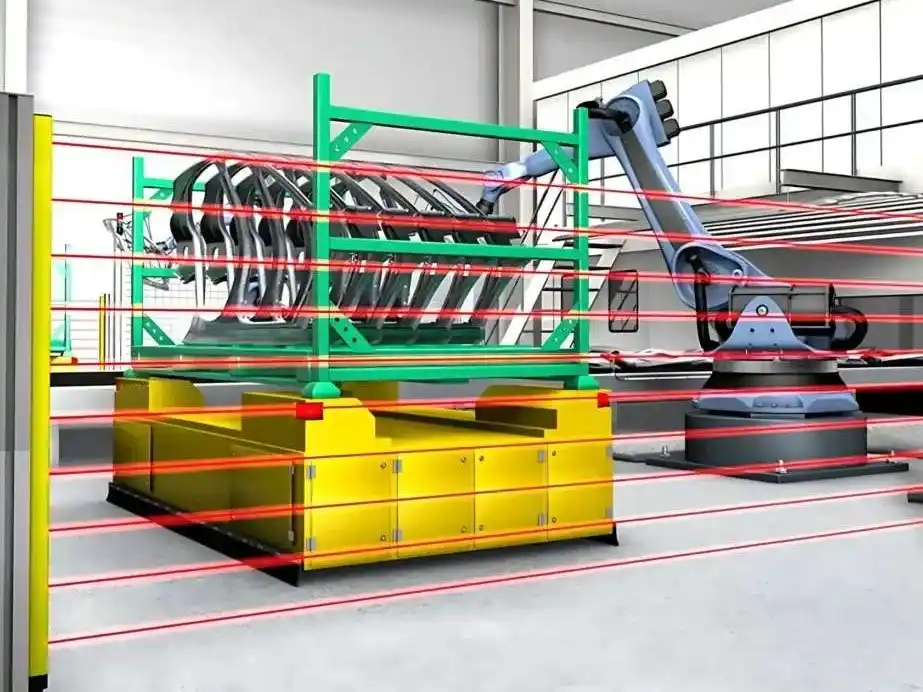
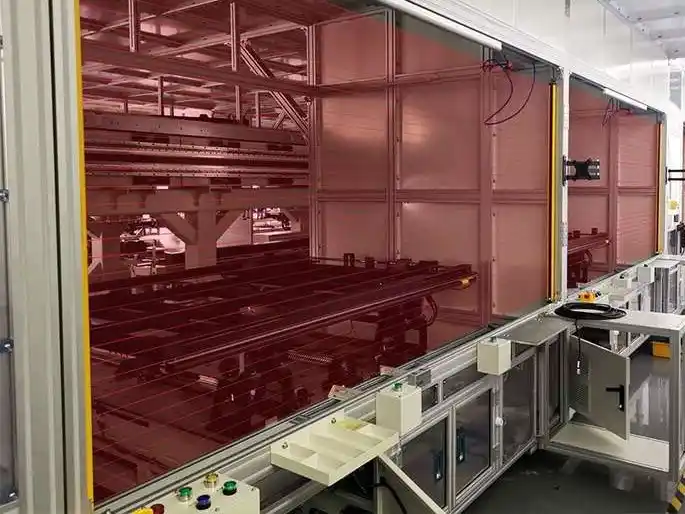
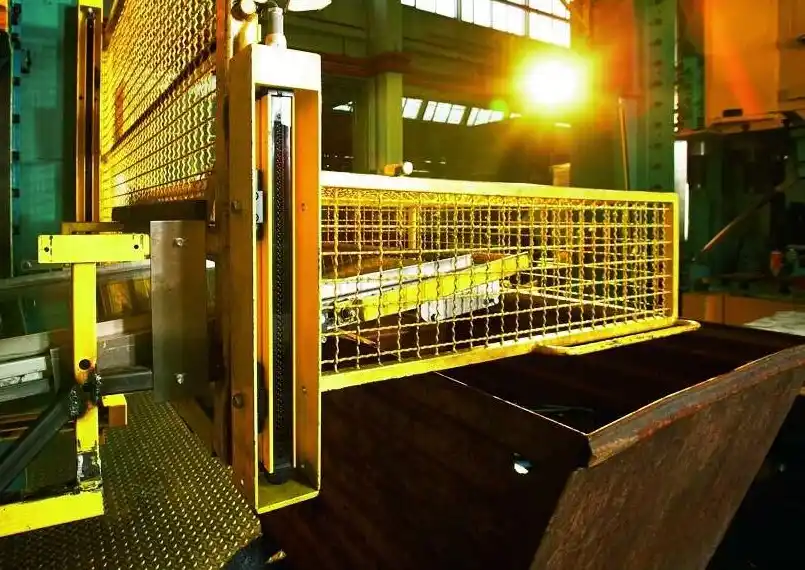
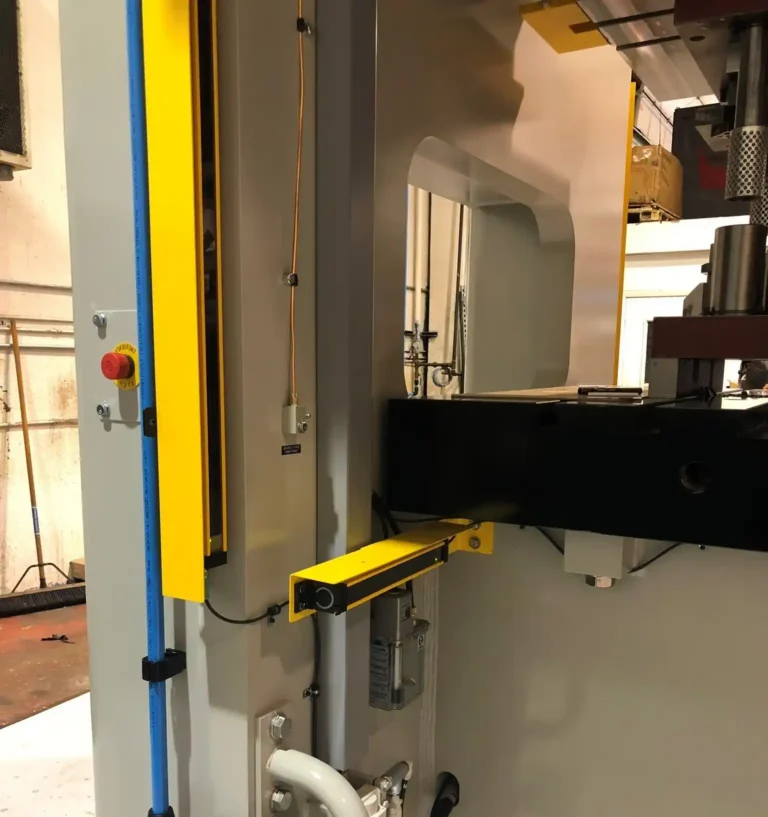
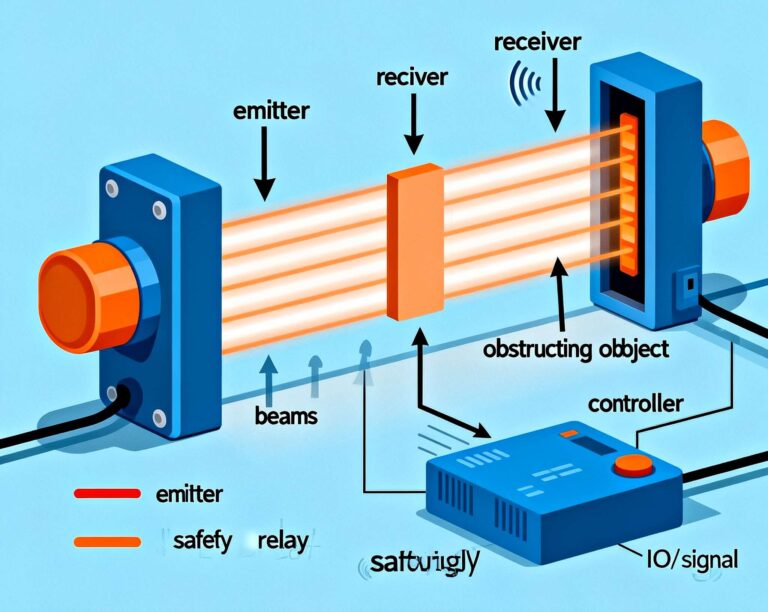
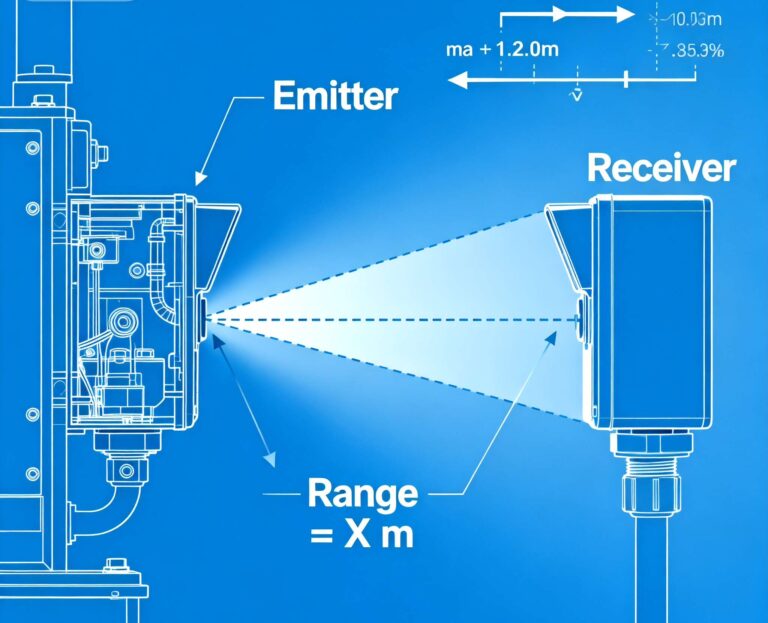
When you put a safety light curtain in front of a press, robot, or conveyor infeed, you’re not just installing a sensor. You’re deciding how much time the machine has to stop before a hand, arm, or full body gets into the danger zone.
That’s why machine stop time and safety distance always travel together. If the machine needs more time to stop, you must place the light curtain further away. If you shorten the stop time, you can move the curtain closer and still stay inside EN ISO 13855 and ANSI B11.19 rules.
Machine stop time and safety distance calculation (EN ISO 13855 and ANSI B11.19)
Both main standards use the same basic idea:
Safety distance depends on
how fast a person can move toward the hazard, and
how long the whole system needs to stop.
The common formula looks like this:
S = K × T + C
Where:
S – minimum safety distance between light curtain and hazard
K – approach speed of hand or body (mm/s)
T – total stopping time of the system (s)
C – penetration distance, based on light curtain resolution and geometry
ANSI B11.19 just breaks T into more pieces (machine stop time, control time, light curtain response, brake monitor, etc.), but for a daily engineering talk you can think of it as one total stop time.
A simple way to read it: if T doubles, and everything else stays the same, S almost doubles. That’s the “versus” in stop time vs safety distance.
Key variables in safety distance calculation
Symbol
Meaning on the shop floor
What you usually check
S
Safety distance
Where you mount the curtain
K
Human approach speed
Hands vs walking body speed
T
Total stop time
Light curtain + control + machine
C
Penetration distance
Depends on resolution and body part
This table looks simple, but it drives every serious project, from a small press upgrade to a full robot line.
Why machine stop time dominates safety light curtain placement
Many teams still look only at “brake time”. That’s risky. Total stop time T must include:
Light curtain response
Safety relay or safety PLC logic
Output modules / contactors
Actual mechanical stopping time
If you ignore the electronic parts and only measure the press brake, you under-estimate T. Then you mount the curtain too close. On paper the math looks fine, in reality the operator can still reach the hazard before motion hits zero.
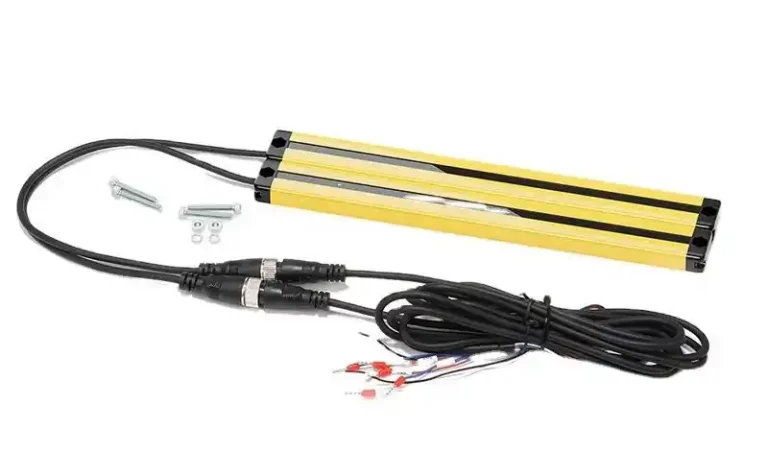
This is exactly where a fast Type 4 safety light curtain helps. With products like the DGD1220 machine safety light curtain or the ultra-thin DCBZ1240 infrared curtain, the sensor response time stays low, so more of your “time budget” belongs to the machine stop, not the electronics.
Penetration distance C, light curtain resolution and safety distance
How resolution of safety light curtain affects C
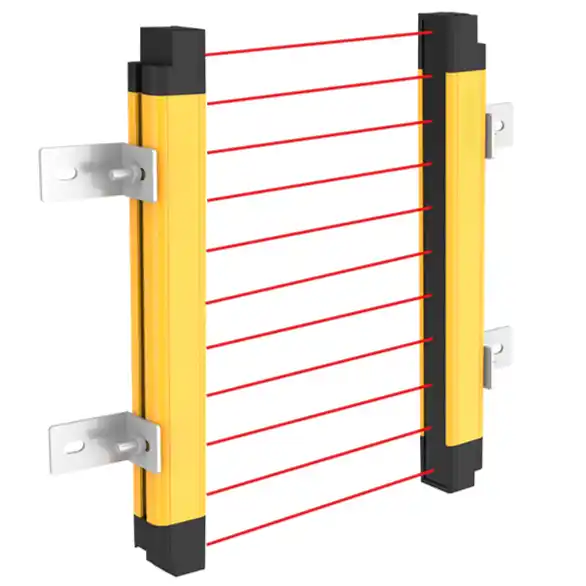
Penetration distance C tells you how far a body part can pass into the light curtain field before the beams actually see it. That number changes with resolution:
Finger / high-precision curtains (for example 14–20 mm)
Can sit closer to the hazard because they see smaller objects early.
Hand / arm or body protection curtains
Need more distance. The standard assumes the person can lean or step further in before detection.
So even if machine stop time T is the same, a high-precision safety light curtain can allow a smaller S than a body-protection grid.
NEW STAR’s product tree is built around these different needs:
High-Precision Safety Light Curtains – for stamping, metal cutting, 3C electronics, battery welding.
General Use and Compact Safety Light Curtains – for standard packaging and assembly lines.
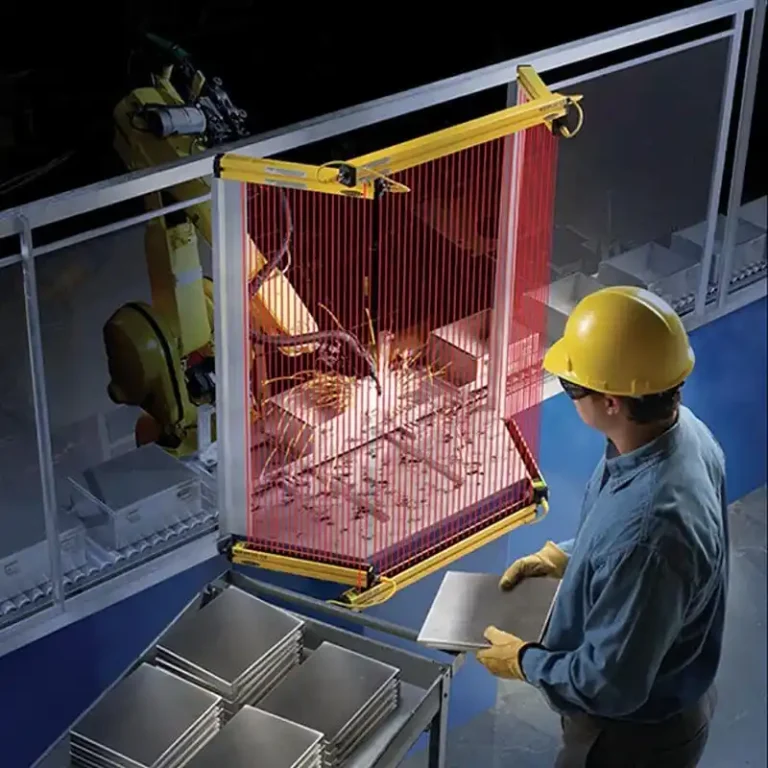
Multi-Sided Access Protection – surround robot cells and palletizers with less hard guarding.
Side Ultra Thin / Front Ultra-Thin – when the machine frame leaves almost no space for hardware.
Picking the wrong resolution means you fight against the formula every time you try to set the mounting distance.
Stop time measurement on real machines and robot systems
On real equipment you shouldn’t guess T. You measure it.
Typical cases where stop time measurement is a must:
Power presses and press brakes in automotive and metalworking
Injection molding machines with fast closing units
Heavy woodworking lines, panel saws, and board processing
Robot cells moving heavy tools or parts
A simple workflow many safety and maintenance teams use:
Run the machine at maximum speed and “worst” production mode.
Connect a stop-time meter at the final control element, for example the motor contactor.
Trigger the stop several times to see variation.
Use the highest value as your T in the safety distance formula.
Repeat testing after brake maintenance, speed changes, major tooling changes, and on a regular schedule.
You’ll see this alot in plants where EHS and maintenance work close together. The machine feels “fine”, but the measured T gets longer over time. Without updating the light curtain distance, the original risk analysis is already outdated.
How stop time and safety distance affect packaging, logistics and robot cell performance
Stop time and safety distance are safety topics, but they directly touch productivity and ergonomics.
On a packaging or logistics system, if stop time is long, the formula forces you to mount the curtain far from the nip point or robot. That means:
Operators walk extra steps to clear jams.
Reach to the working area becomes awkward.
Restart and reset cycles feel slow and boring for the crew.
Here’s a quick view of how operators feel different combinations.
Stop time and distance
How it feels for the operator
Typical equipment
Short T, small S
Curtain close to hazard, easy reach, less walking
New servo press, tight robot cell, high-precision curtain
Medium T, medium S
Guarding ok, but some extra movement
Standard palletizer, injection molding machine, small assembly line
Long T, big S
“Why is this so far away?” more walking, more fatigue
Older crank press, long conveyor cells, big gantry robots
In food, beverage, and washdown zones you get another twist. You need IP-rated safety curtains, so stop time, S, and environment all collide. That’s exactly why solutions like the SWP2840 industrial light curtain exist: proper waterproof housing plus the response time you need for a reasonable distance.
Engineering options when calculated safety distance is too large
Sometimes you run the full calculation with real T, and the result looks impossible. Maybe the curtain would end up in the walkway, or right in front of a pallet lane. You still have options, you dont must accept it.
Option 1 – Reduce stop time T
This is a pure engineering job:
Upgrade or re-tune brakes on presses, saws, heavy conveyors.
Adjust deceleration ramps in drives and servo controllers.
Clean up the safety chain: short and clear logic in the safety PLC, fast safety relay, no “mystery” delays.
Shorter T means smaller S, without changing the light curtain type.
Option 2 – Reduce penetration distance C with better curtain design
If current guarding is more like body detection, C is large. Switching to a high-precision curtain or a compact Type 4 model can reduce C and bring the curtain closer to the hazard.
For example:
In an electronic assembly line you can use a compact curtain like DGD1220 close to the tooling.
On measurement and quality stations, a dedicated measurement light curtain handles dimension check, while a separate safety curtain handles reach-in protection.
On process skids with pumps and tanks, you might combine safety curtains with a flow sensor to watch both moving parts and liquid lines.
When you design both T and C smart, the light curtain placement becomes a tool for safety and for better takt time, not a barrier.
Matching stop time, safety distance and NEW STAR safety light curtains
NEW STAR positions as a one-stop machine safety sensors manufacturer, with ISO9001 factory and OEM/ODM capability from single sample to mass batch. That sounds like marketing, but it actually matters for stop time and safety distance:
You can order custom protective heights to match your calculated S, instead of stacking random sizes.
Different series cover presses, injection molding, logistics, woodworking, metal cutting, robotics, DWS systems, battery and 3C lines, so you don’t need ten suppliers.
For EHS managers, safety engineers, process owners and buyers, having one partner for safety light curtains, measurement curtains, photoelectric sensors, safety devices, flow monitoring makes audits and compliance much simpler.
When automation engineers talk about EN ISO 13855, EHS talks about risk reduction, and purchasing talks about delivery and batch orders, everyone is still looking at the same hardware family on thelightcurtains.com.
Practical checklist for engineers, EHS and buyers
Before you sign off the next cell or line, run through this quick list:
Do we have recent stop time measurements for each hazardous motion?
Did we include sensor response + control time + brake time in T, not just the mechanical stop?
Is safety distance S calculated from the correct approach speed and body part?
Does the chosen curtain resolution match the risk: finger, hand, or full body?
Is the mounted distance on the machine the same as in the calculation note?
Do we have a plan to re-measure T after major maintenance, speed changes, or tooling changes?
Have we picked the right NEW STAR series (Compact, Heavy Machine, High-Precision, Multi-Sided, Waterproof) for each station’s real-world use?
If you can tick those points, your stop time vs safety distance story is in much better shape. And when you want that story to connect to real hardware, OEM customization, and wholesale batches, you know you can grab it straight from thelightcurtains.com.